El archivo y el viento: sobre Cien años de soledad, de Gabriel García Márquez
1. This Is the Cow
Somebody hangs a sign on a cow.
It happens in the fourth chapter, while the town is going quietly out of its mind. Nobody in Macondo has slept for weeks; nobody has minded much, at first, because the hours gained have been spent finishing the housework, embroidering, telling the same jokes until the jokes wear through. Then the nouns begin to go. A man looks at the anvil and cannot retrieve the word for it. So the Buendías take an inked brush and label the world: the table, the chair, the clock, the door, the wall, the bed, the pan. And on the cow they hang a placard that does not stop at the animal’s name. It explains that she must be milked every morning, that the milk must be boiled, that the boiled milk must be combined with coffee to produce coffee with milk.
That placard is the most frightening object in the novel, and it is funny, and its comedy and its terror are the same substance. It is funny because of the escalation — the patient bureaucratic helpfulness of a species that has begun to lose its mind and responds with signage. It is terrifying because of what the escalation reveals. The word cow is useless without the word milk; the word milk is useless without boil; boil is useless without a memory of fire and of hunger and of the particular morning pleasure that makes any of it worth doing. The sign cannot arrest the slide, because a definition is not a practice. Each label requires a further label, and the chain of explanation has no floor. Language survives. Competence does not. What remains, at the end of the process, is a fully documented world that nobody can operate.
José Arcadio Buendía, who is the town’s founder and its most tireless enthusiast for hopeless projects, grasps the principle faster than anyone and responds with an invention. He designs a memory machine: a spinning apparatus carrying some fourteen thousand entries, everything Macondo knows, reviewable each morning from beginning to end. He does not finish it. Melquíades returns from the dead — he had died of a fever in the swamps of Singapore, and found the solitude of death intolerable, and came back — and cures the plague with a gently colored drink, and the nouns come home, and the episode closes the way a fever breaks, leaving behind a mild embarrassment and no lesson whatsoever.
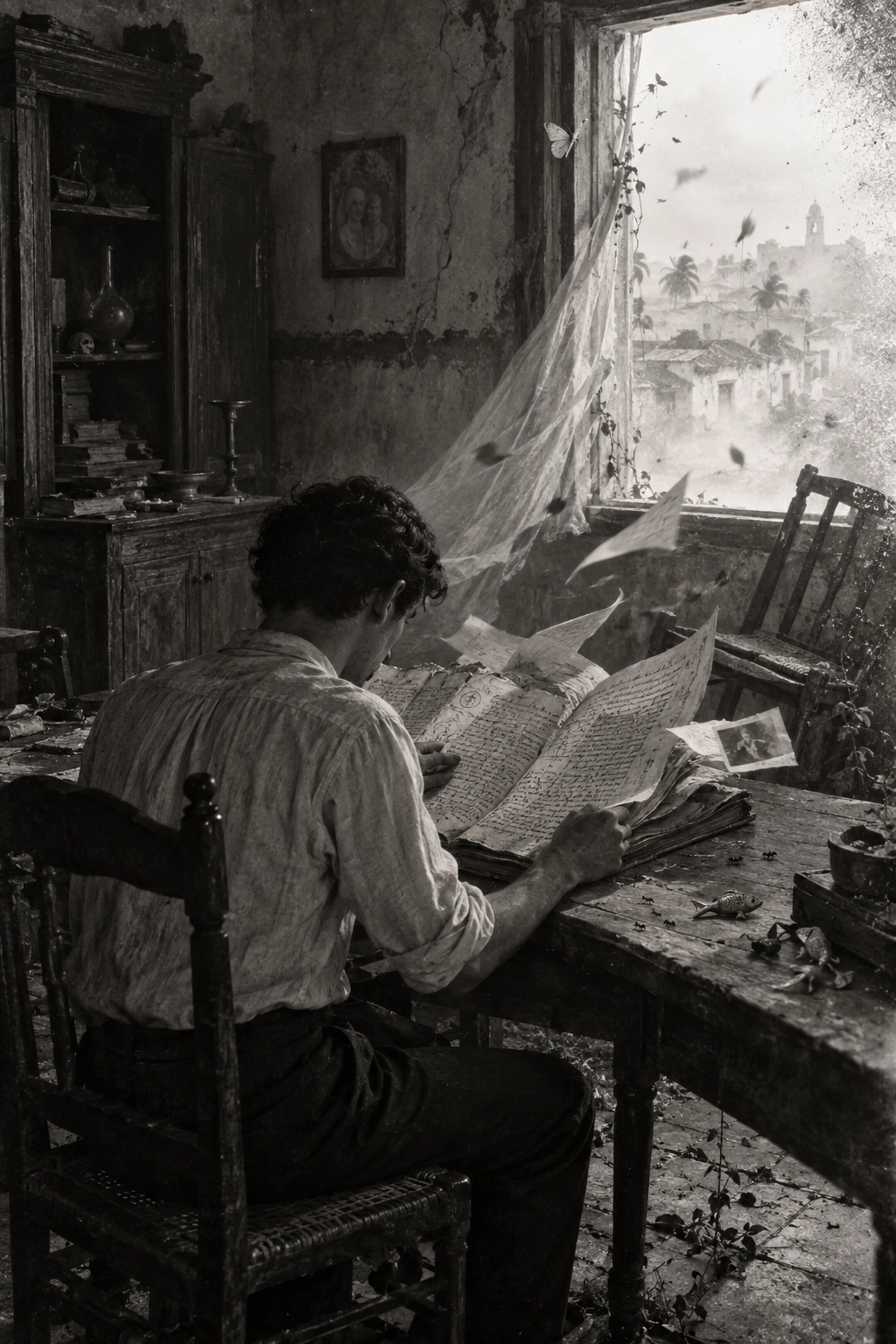
Hold the image of that spinning dictionary. Ninety years and five generations later, in a room in the same house, a young man will sit down with a stack of parchments written in Sanskrit and encrypted twice over, and discover that the entire history of his family — every birth, every war, every adultery, every stupidity, every death, including his own, including the wind that is at that moment tearing the roof off the house — was written down before any of it occurred. The record was always complete. It was always in the building. It was simply illegible, and its illegibility was not an accident of cryptography but a condition of life in that house.
Between the cow’s placard and Melquíades’s parchments, One Hundred Years of Solitude runs its argument. This is not a family chronicle decorated with charming supernatural weather, and it is not a fable about the enchantment of a tropical village, whatever a half century of jacket copy has managed to suggest. It is a book about a society in which experience never hardens into shared knowledge. Things happen in Macondo — appalling things, hilarious things, decisive things — and then they are remembered privately, distorted publicly, renamed politically, folded into legend, or denied outright by men with documents. Nothing accumulates. The town forgets faster than it lives. Each generation approaches the same cliff with the same expression of pleasant surprise.
The novel is extremely precise about this, and its precision has a strange consequence: the book’s famous marvels turn out to be the least of its provocations. A woman rises into the sky while folding laundry and the narrator reports it as a domestic inconvenience, because a sheet goes up with her and the sheets were good ones. A priest levitates a few inches off the ground after drinking hot chocolate, and uses the trick to raise money for a church. A trickle of blood travels across town, turns corners, climbs a curb, avoids a carpet, and arrives in a kitchen to inform a mother that her son is dead. These events are narrated without a change of pressure, and readers accept them, and accept them easily, which is itself worth pausing over.
What readers find difficult, what the book itself stages as unbelievable, is a fact from the historical record. Toward the end, soldiers open fire on a crowd of striking banana workers gathered at a railway station. The dead are loaded onto a freight train and carried to the sea. One man survives, walks home, and tells people what he saw, and is met everywhere by the same mild, kindly, unanimous correction: there was no massacre, nobody died, the workers went home to their families, Macondo is a happy town. The denial is repeated until it is taught in schools. He goes ...