I. “Hey, What’s That From?”
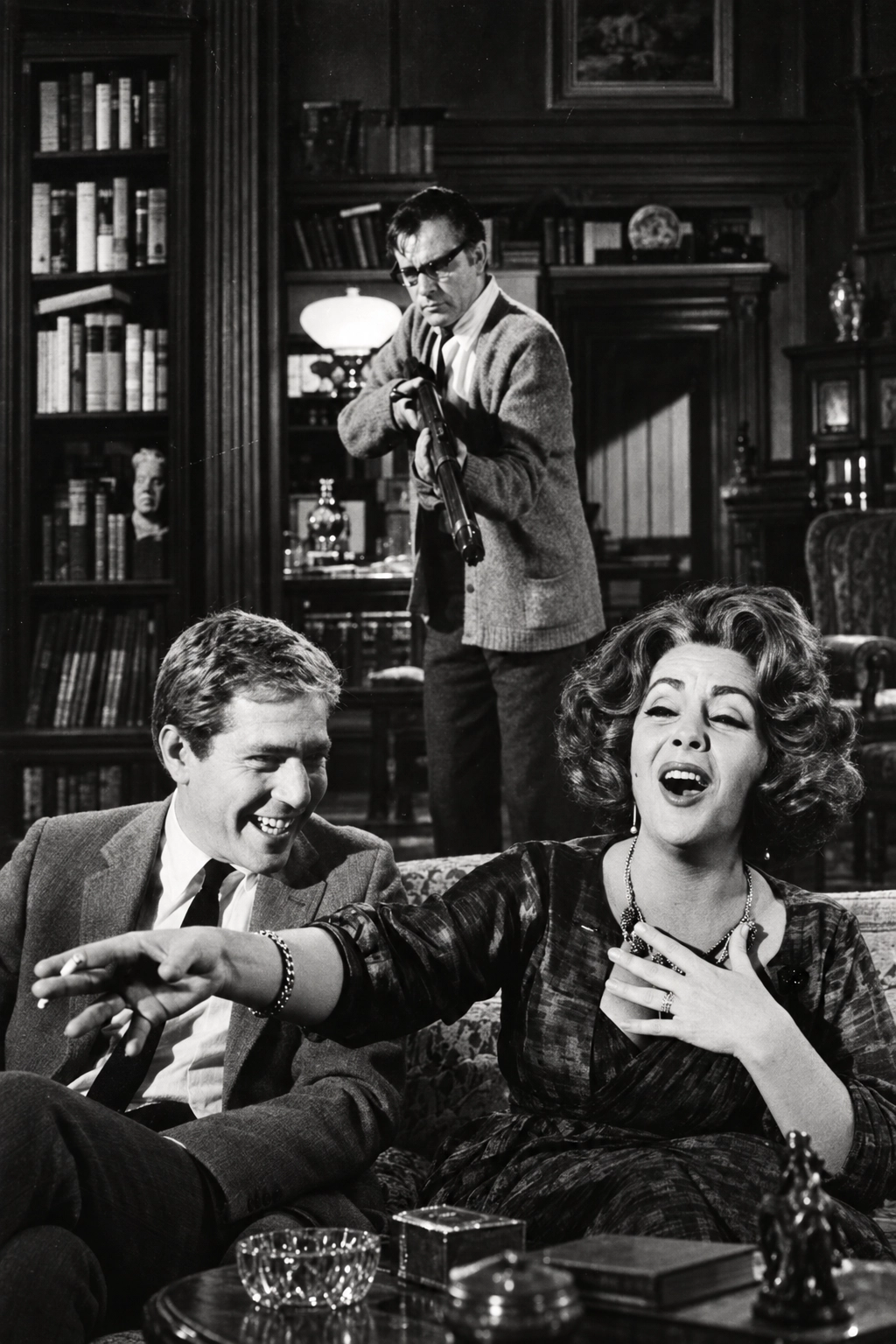
A hand finds the wall switch, and the living room arrives all at once: books on every flat surface, newspapers, glasses left where they were emptied, ashtrays nobody has dealt with, the accumulated sediment of two people who have spent years reading, drinking, and declining to tidy up for each other. Elizabeth Taylor stands in the middle of it, squinting against the light she has just made. Her Martha surveys the place as though somebody else had been living there. Then she borrows a voice and passes sentence: “What a dump.”
It is not her voice, and that is the first thing to notice about the first line of dialogue in the film. Martha comes into her own house doing an impression. The swooping, bitten-off delivery belongs to Bette Davis, and Martha wants the likeness recognized. “Hey, what’s that from?” she asks her husband, and asks again, and goes on asking through two rooms while he declines to know. It sounds like late-night trivia. It is also a fair sample of how these two people deal with each other: a performance is offered, a response is demanded, the response is withheld, and the withholding becomes the next topic. No guest has rung the bell yet. Martha already has an audience, and George is already refusing to be one.
Mike Nichols has made us wait for this. For the length of the credits there has been next to no talk: a moon behind branches, good-nights called at the door of a lighted house, and then a long walk home across a sleeping campus, accompanied by a slow, grave tune for plucked strings that Alex North has written to sound almost like consolation. The figures are small and far off. We know who they are because the titles say so, and because in 1966 few faces on earth were better known, but the film keeps those faces from us, and it keeps the voices too, except for one ragged laugh of Martha’s that carries across the lawns as the title comes up. This is the only stretch of the film in which George and Martha are seen from a distance, saying nothing to each other that we are meant to catch, and it lasts just long enough to feel like a kind of peace. A couple is walking home from a party. The rest of the film will close that distance by stages, until faces crowd the frame and the pores show, and the rest of the soundtrack, very nearly, will be talk.
Edward Albee’s play begins at the front door, with a crash, a laugh, and the lights coming up on the room where all three acts will be spent. To start a few minutes earlier and a few hundred yards away is the film’s first act of adaptation, and it alters the meaning of the house before anyone has set foot in it. On the stage the living room is the world. On the screen it is a place that two people walk toward through the dark, of their own accord, knowing perfectly well what is inside. The campus is Smith College, in Northampton, Massachusetts, where the company spent five wet weeks of night shooting in 1965. The college had stipulated that it not be recognizable, and hardly any of it is; Nichols later said that the location had been an unnecessary insistence, and for much of what was shot there he may have been right. The walk, though, needs its real darkness and its real distances. When the film afterward leaves the house, for a yard, a car, a roadhouse, and a parking lot, those departures will be measured against this first approach, and so will every return.
From the living room the film goes where the play could not, into the kitchen, and there, at the open refrigerator, Martha explains her quotation. She has found a piece of cold chicken, and she eats it standing up, talking through it, with the door hanging open beside her. Taylor establishes more about Martha in these seconds than the dialogue does. This is a woman entirely at ease in her body and her appetites, who eats in front of her husband exactly as she would eat alone, which is one definition of intimacy and also one definition of having stopped trying. Between bites she narrates. Bette Davis comes home with the groceries; she is a housewife; she is married to Joseph Cotten, or something; she walks into her modest living room, looks around, sets the groceries down, and says the line. “She’s discontent,” Martha concludes, with the satisfaction of a critic who has located the theme.
The joke is broad, and the film lets it stay broad. What the staging adds is that Martha has just performed the scene she is describing. A discontented wife came home, looked around her living room, and delivered a verdict; the reference is also a stage direction. She is telling George what sort of picture they are in tonight and who has the Davis part, and she leaves the Joseph Cotten role, the dull decent husband whose name she can barely retrieve, conspicuously open. The picture she cannot name is Beyond the Forest, a Warner Bros. melodrama of 1949, and the film never supplies the title any more than George does. His single guess, “Chicago,” is merely the city ...