I. A Stunt and Its Alibi
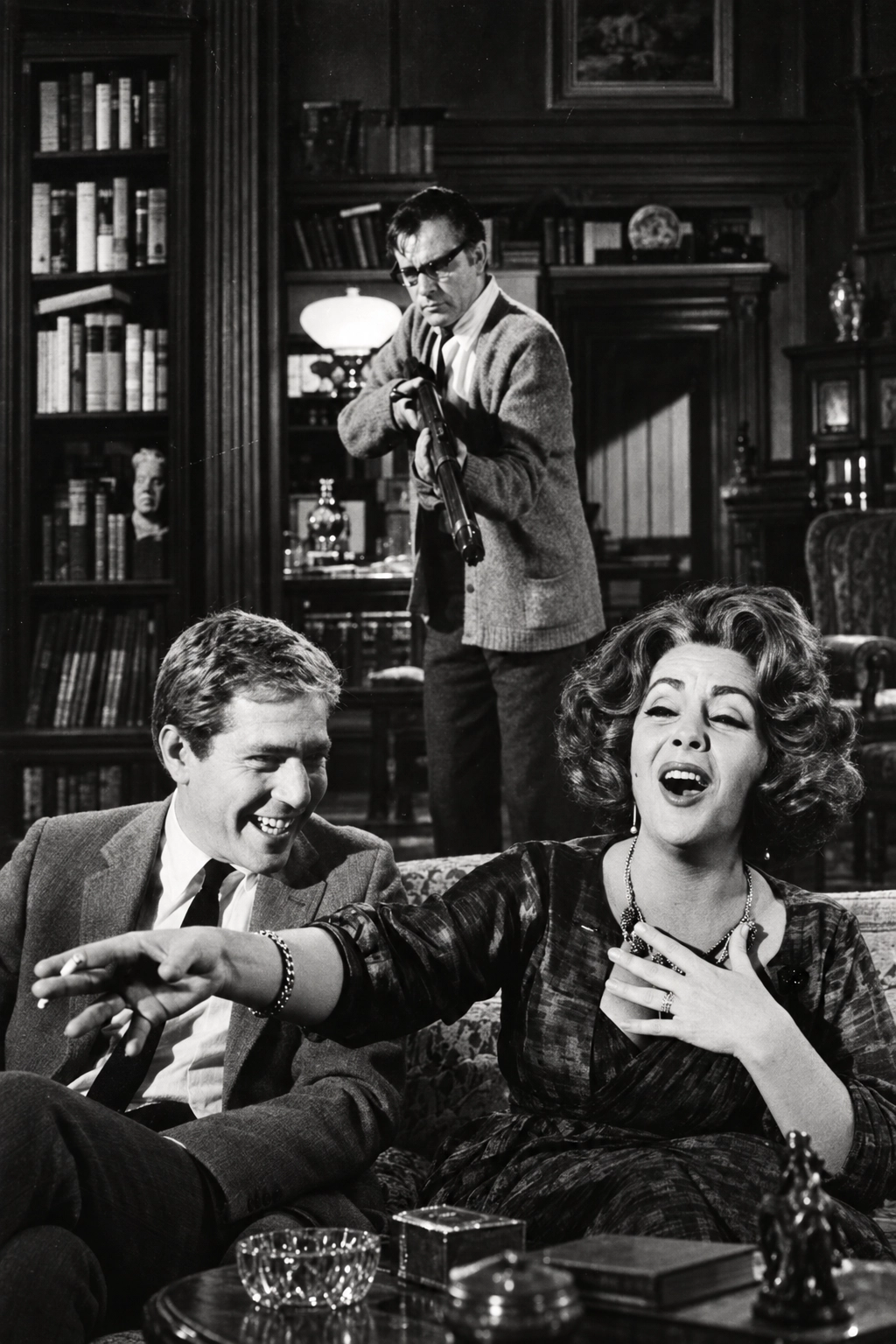
Rope was the first production of Transatlantic Pictures, the company Alfred Hitchcock formed with Sidney Bernstein, and the first film he shot in Technicolor. Warner Bros. distributed it; the New York opening came in late August 1948. Arthur Laurents wrote the screenplay from Patrick Hamilton’s 1929 stage play, with an adaptation credit to Hume Cronyn. Shooting began on a Warner Bros. sound stage in January of that year, on a three-room penthouse whose walls hung from overhead tracks so that grips could swing them clear of the camera, and whose furniture — including the chest at the centre of the story — rolled on castors. Beyond the windows stood a semicircular cyclorama of roughly twelve thousand square feet, backed by a miniature Manhattan in forced perspective, its chimneys smoking and its windows lighting in sequence. Clouds of spun glass were repositioned between reels so that the sky would appear to move, and nearly two hundred miniature neon signs were wired to a single console and played, on cue, like an instrument.
The camera ran in takes limited by the thousand-foot magazine, that is, to something under ten minutes, and the completed film consists of ten or eleven shots depending on how one counts the opening. Half the transitions between them are conventional cuts; the other half are masked, the camera pressing into a dark surface until the frame goes black and the join occurring inside that darkness. The alternation was not aesthetic caprice. Projection reels of the period held roughly twenty minutes, and a projectionist executing a changeover needed a clean, unhidden edit to work against; every second transition therefore had to be visible whether Hitchcock wished it or not.
Speaking to François Truffaut nearly two decades later, Hitchcock disowned the method, calling it a stunt he could not entirely account for. The self-assessment has proved durable, and it has functioned in the critical literature as a kind of alibi: the film gets discussed as a technical curiosity with a thriller attached, or as a thriller compromised by a technical curiosity. Both framings treat the continuous take as a container for content rather than as content. Peter Wollen’s account of the film’s competing structural logics and D. A. Miller’s 1990 study of its regime of connotation each pushed against that habit, from different directions, and both remain indispensable. The argument advanced here takes a third route.
Rope is commonly described as a film about whether a philosophical doctrine can license murder. It is more precisely a film about the difference between holding an idea and wearing one — between a doctrine and a manner — and about what happens when someone mistakes the second for the first. Everything in the picture is organised around this distinction: the etiquette of a dinner party, the connoisseurship of a former schoolmaster, the pose of the superior man, and, decisively, the film’s own manufacture. The continuous take makes exactly the wager Brandon Shaw makes. It proposes that an act can be performed once, without seam or second chance, and stand complete; the film then spends eighty minutes demonstrating that no such act exists, and locates the demonstration in its own joins. The masked transitions are staged, repeatedly, on the back of the man who conceals; the unmasked ones open, more than once, on the face of the man who exposes. The film’s editing does not illustrate its theme. It is divided between its two antagonists, and the division is the argument.
II. An Irony and Its Descendants
Because the film’s ancestry is regularly compressed into a single sentence about a famous crime, the distinctions deserve stating carefully. In May 1924 in Chicago, Nathan Leopold Jr. and Richard Loeb, both from wealthy families and both academically precocious, abducted and killed a fourteen-year-old boy, Bobby Franks. They were identified within days. Clarence Darrow, retained by the families, entered pleas of guilty, converting the proceeding into a sentencing hearing before a single judge and removing a jury from the equation; his address against capital punishment ran for hours across several days. Both defendants received life sentences. Loeb was killed in prison in 1936; Leopold was paroled in the late 1950s.
The philosophical dimension is where popular memory and record diverge most. Nietzsche was invoked at the hearing, but not in the way the legend suggests: Darrow raised the philosophy in order to diffuse responsibility. He asked, in substance, where a young man acquires such a doctrine, observed that it is taught in every university and stocked in every library, and proposed that the institution which supplied it bore more blame than the student who absorbed it. In passing he drew the distinction on which the entire logic of Rope would later turn: between reading a philosophy as a speculation entertained at arm’s length and fashioning one’s life upon it. His use of it was exculpatory. He was arguing that his clients had failed to observe a boundary educated men observe automatically, and that the failure was a symptom rather than a choice.
Hamilton’s relation to the case is genuinely unsettled and should not be reported otherwise. He denied, consistently, having known of it before writing; his brother stated the opposite; his biographer has judged the resemblances too dense for coincidence. What Hamilton did acknowledge, in a contemporary notice of the play’s New York run, was a debt ...