A mechanic tells Martin Sloan that the oil change and lube job will take about an hour. Nothing that follows contradicts him. Whatever happens on the road to Homewood happens inside that window, and when Martin comes back the car is ready, and he gets into it and drives away. Somewhere in the interval he has been to 1934, to a summer evening in a park, and to the last conversation he will ever have with his father. The past is not a country requiring an expedition and a permit. It fits in the gap between dropping the car off and picking it up.
Before the walk there is the horn. Martin arrives leaning on it, three or four flat blasts aimed at a man bent over an engine part who has no intention of hurrying for anybody. The attendant straightens up slowly, puts the part down with some deliberation, and offers, in place of service, a request for quiet. Then Martin’s face comes apart. He apologises. He apologises a second time, which is the apology that matters, because nobody asked for it and because it arrives with the particular urgency of a man who has just heard himself. He is not a bully. He is somebody travelling at a speed he is ashamed of and cannot get out of, and the first stranger he meets simply declines to be pulled along at it.
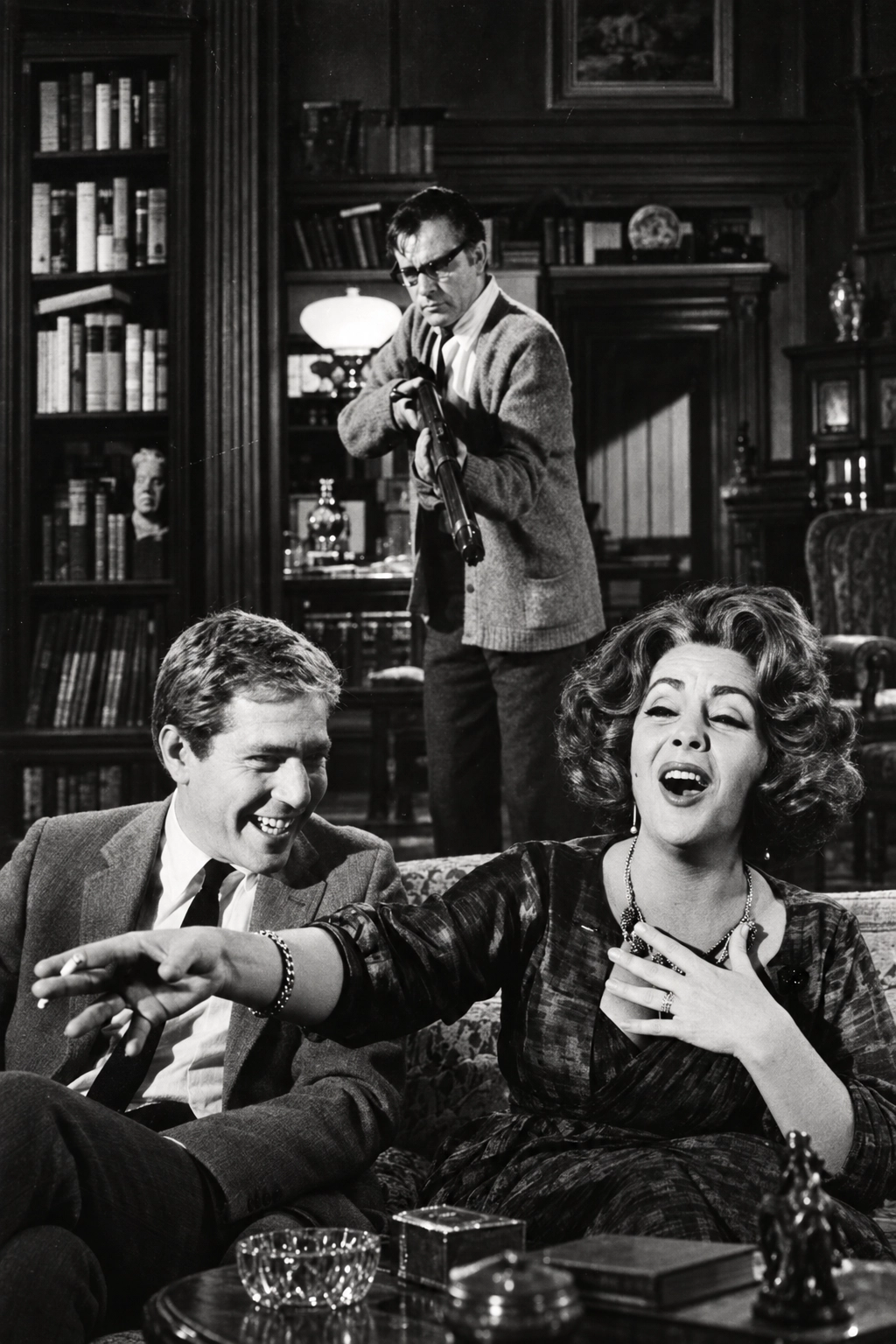
That is Gig Young’s first and best move, and it is over in about ninety seconds. In 1959 Young was the most reliable second man in American pictures, twice nominated in the supporting category, a specialist in the amiable friend with a glass in his hand who loses the girl in the last reel and takes it beautifully. The persona was made of ease. What he does with Martin Sloan is show ease as labour. The charm still works, for the soda jerk, for a woman with a baby carriage, for anyone who will hold still, but it arrives half a second late every time, and when it fails nothing replaces it. He has no second manner.
He asks the attendant how far the town is. A mile and a quarter, the man says, and then, pressed, about a mile and a half. Martin supplies the phrase himself. He says it quietly, the way you would say it about a restaurant from a hotel, and the flatness of the language is the point. Walking distance is a real-estate courtesy, a thing printed in brochures, naming the radius inside which a body can reach a thing without help. Martin puts that phrase on his childhood and finds, to his own quiet astonishment, that it fits.
He does not cross a threshold. Robert Stevens, who had directed the pilot and some forty episodes of Alfred Hitchcock Presents and admitted to a weakness for mirrors, sends the camera at the service station into the glass above a cigarette machine, where Martin is already small and already far down the road. A dissolve, and the next thing on screen is his reflection in the drugstore mirror as he comes through the door, the camera craning back off it into the room. He leaves one decade in a mirror and arrives in another one in a mirror. No shimmer, no gate, no clock face spinning. The walk is elided in a reflection, which is tactful, since the part nobody can explain is the part we are not shown.
The impossible is served at the counter with a paper napkin beside it. A chocolate soda, three scoops, ten cents. Martin’s delight has a slightly wild edge even here. He tells the man behind the fountain that he used to spend half his life in this room, that the town looks exactly the same, that he would have bet money everything would have changed. When the price comes he laughs and says the place is going to lose its shirt, and leaves a dollar for a dime soda, which is the tip of a man from somewhere else. He is having the best afternoon in years, and the audience is a step ahead of him, doing sums.
Then comes the finest small thing in the teleplay, and it is not about Martin at all. On his way out he mentions old Mr. Wilson, who used to doze in a big chair in the back room before he died; that image, he says, is one of the ones he keeps. He goes. The soda jerk rinses the glass, notices the syrup containers running low, and walks to the door at the far end of the room, where a white-haired man is asleep in a chair. He wakes him. They will need more chocolate syrup. Wilson says he will order some this afternoon, and winks, and goes back to sleep.
Martin stood six feet from his dead man and did not look. The proof he will spend the rest of the evening tearing at strangers to obtain was in the next room the whole time, and it is handed instead to us, and handed as a note about the syrup supply. There is nothing reverent in it. Homewood is not a shrine. It is a going concern with stock to order and an afternoon still ahead of it, and the miracle it performs for the viewer is domestic and faintly comic. Everything cruel in the ...