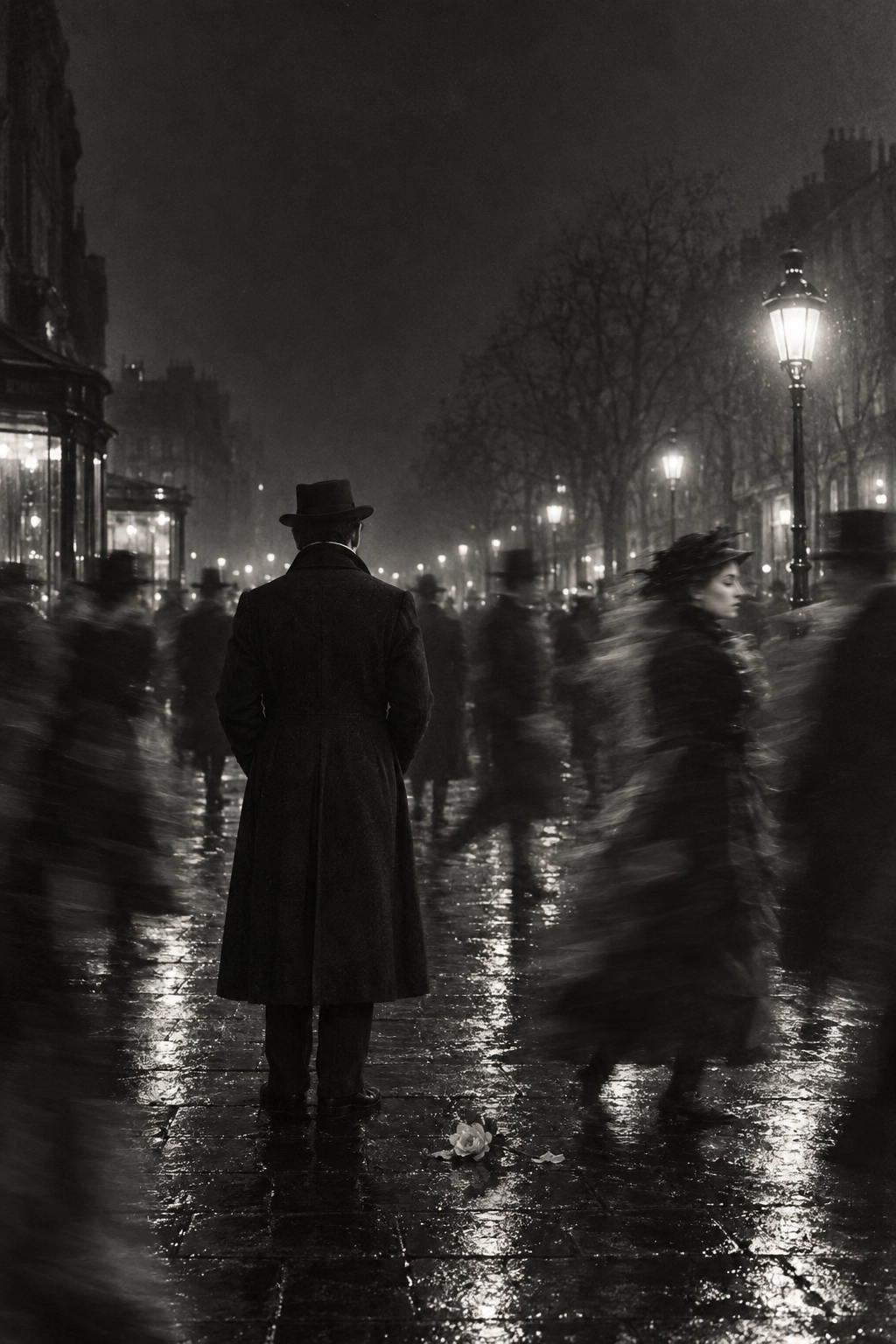
He opens a suitcase on the sidewalk and the street changes shape. People who were walking in a line arrange themselves into a curve; the curve acquires a center; the center is a valise of thread and neckties and a toy robot. Nothing has been sold. It is entirely possible that nothing will be sold. The essential work has already been done.
Lew Bookman’s trade deserves that kind of precision, because everything the episode eventually does with mortality rests on our understanding what a pitchman actually manufactures. Not ties. Not thread, not toys, not any of the small unnecessary objects riding in the valise. He manufactures a pause. He takes people who are on their way somewhere and persuades them to be, for ninety seconds, nowhere. The merchandise is a pretext for the pause, and the money, when it comes, is a receipt for something that has already happened.
Serling’s narration files him with a clerk’s efficiency. Summer, a sidewalk, a man of about sixty, occupation pitchman, a minor component of a hot July, his life “a treadmill built out of sidewalks.” The description is accurate and worthless, in the way that accurate descriptions of people are generally worthless. It is also, in one small particular, wrong: the narration says sixtyish, and Ed Wynn, who was in his seventies when this was shot, does not remotely look sixty. He looks like a man who has been standing on pavement since before there were microphones. The gap is tiny and it sets the terms. Something has already been undercounted before the story begins.
The children arrive and he does not sell them anything, which is not the same as failing to sell them anything. He gives things away. They have no money and he knows it and he performs for them anyway, working the toy, working the patter, playing to an audience that cannot possibly buy. It would be easy to take this as the episode’s certificate of his goodness and move on. The trouble is that it also describes a professional arrangement of some convenience. An audience of children never walks away mid-pitch. It never says the price is too high, never compares him to a better man on a better corner, never declines. Bookman has spent his working life in front of the one crowd that cannot refuse him and cannot judge him, and he has done this while telling himself that his great performance is still ahead.
Look at what is actually in the valise. Thread and needles and yarn. Neckties. Socks that are not quite cashmere. Remedies for the feet and the skin. It is an inventory of small repairs, the equipment for keeping a shabby life presentable through another week, sold on a corner to people who cannot afford the shop. And in among the menders, a toy. The toy is the only object in the suitcase that fixes nothing, and it is the thing he gives away.
That is the man. Not a saint with a suitcase. A gentle, evasive, garrulous person who has arranged things so that he is loved daily and tested never, and who carries around inside him the idea that the pitch of his life has not yet been made. Wynn plays the whole tangle without editorializing. The voice goes up at the ends of sentences and hovers there, asking to be liked. The hands move ahead of the words, describing objects in the air before the mouth reaches them. He laughs at the seams of his own speech, a small apologetic laugh that clears a path for the next sentence. Watch him with the children and you see a man doing what he is best at. Watch him a moment longer and you see a man practicing for something that never comes.
What arrives instead is a man in a dark suit who wants nothing.
He is already inside. Bookman climbs to his own room at the end of a working day and the man is simply there, waiting, in a space small enough that a stranger in it constitutes an event. Nothing has been forced. Nothing is disturbed. The most ordinary safety a person has, the assumption that the room he pays for holds only what he left in it, has been withdrawn without noise. And Bookman’s first response is closer to fussing than to fear. He objects, the way any tenant objects, and the objection keeps sliding into hospitality, because he cannot help himself. Someone is in the room, and someone in the room has to be talked to.
Murray Hamilton’s Death is the most disciplined piece of work in the episode, and its discipline consists almost entirely of what he declines to do. He does not loom. He does not lower his voice into the cellar. He wears a suit in July and appears untroubled by the heat, and he carries himself with the mild, faintly tired courtesy of a man who has been doing the same job for a long time and has stopped expecting it to go smoothly. When the narration names him, he turns and looks straight into the camera. It is the only moment in which the episode acknowledges that anyone is watching, and it lands like a hand on the shoulder. He is not being introduced to us. He is confirming that he knows we are there.
Everything frightening about him follows ...