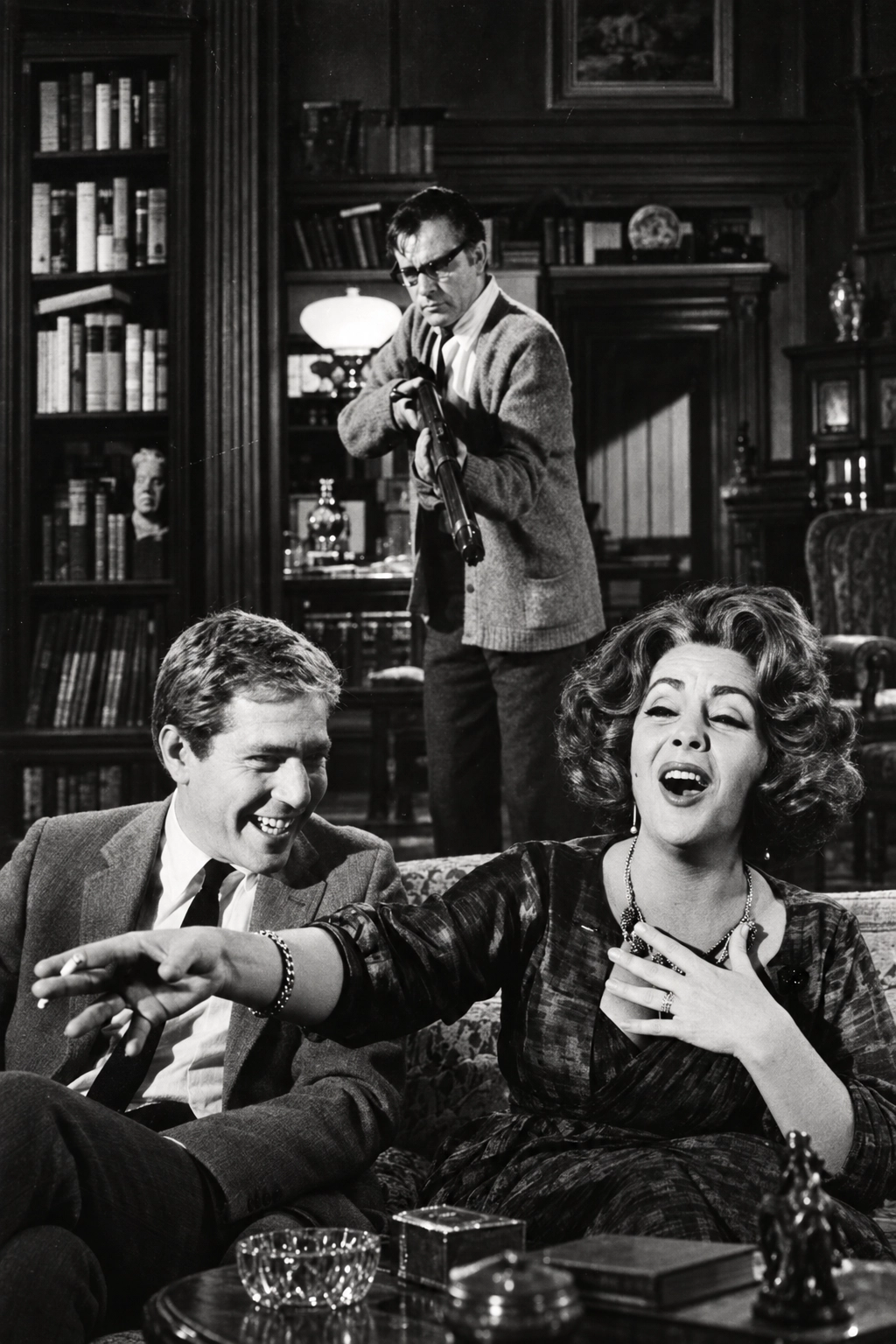
The Trick
In the playroom at the top of the Seton house in Holiday (1938), Cary Grant turns a back somersault. He is playing Johnny Case, a man who has worked since he was a boy and has decided, at thirty, to stop for a while and find out what the work was for, and he has just been explaining this to Linda Seton, who is Katharine Hepburn and the only member of the household likely to understand him. The room was Linda’s as a child and is full of old toys and shabby furniture; George Cukor treats it as the one place in the mansion where nobody is being appraised. Grant stands, settles his feet, drops his hands, and goes over backward, tucking, turning, and landing where he started. Cukor films the flip in full figure, without a cut, and does not hurry to a reaction. A man who was introduced to us in a dark suit has turned himself upside down in front of the woman he is going to love, and he has done it as a skill, without fuss, the way another actor might light a cigarette.
The flip carries the character’s argument. Johnny’s speech about wanting to get off the money ladder before it carries him to the top had been made by other people in other Philip Barry plays, and on the page it has a faint sermonizing hum. The somersault turns it into a fact about a body. Here is a man who can leave the ground and come back to it, and who evidently enjoys the interval. That is what the film asks the Setons to believe about him, and Cukor lets Grant prove it with the one instrument that cannot lie in an unbroken take, his own trained weight. At the end of the film, in a ship’s corridor, Grant turns the flip once more and comes out of it to find Linda waiting.
I begin there because the somersault is the least mysterious thing about Cary Grant and it explains more than the mysterious things do. Grant had learned it as a boy. Between the ages of fourteen and eighteen he was a member of Bob Pender’s troupe of knockabout comedians, and by his own later account he was taught tumbling, stilt-walking, pantomime, and dancing, and performed them nightly in British music halls and then, from 1920, in American vaudeville houses.[1] The description of him that has hardened into cliché, the elegant man in the good suit, tends to treat this training as a colourful prelude, something he left behind when he put on the dinner jacket. I want to argue the opposite. What an acrobat learns, above everything, is where the floor is. He learns to fall without hurting himself, which means learning to fall on purpose; he learns to be watched while off balance and to make the watching pleasurable rather than anxious; he learns that the grace of a landing is manufactured in the half second before the leap. The screen identity that came to be called Cary Grant was, in its most basic material, a body that always knew where the floor was and could therefore afford to leave it. His elegance never asked to be believed. It asked to be tested, and the films that used him best were the ones that did the testing.
That is a claim about performance, and it can be checked against particular scenes: a chair going over backward in The Awful Truth, a leap in a negligee in Bringing Up Baby, a man standing very still in a cornfield in North by Northwest. It is also, I think, a way of understanding the shape of the career. In the comedies of 1937 to 1940 the directors who understood him spent four years knocking him down. In the 1940s Hitchcock found out what happened when he refused to fall. In the 1950s Hawks demolished him twice more and Hitchcock, McCarey, and Donen taught him to sit down. The last films are about a man deciding for himself when to leave the floor for good, and the withdrawal, when it came in 1966, was as well timed as anything he did on screen. None of this reduces to a formula, and some of the best performances resist it, but it keeps the attention where it belongs, on what the man actually did in front of a camera.
Learning the Floor
The biographical facts that matter here are few and well established, mostly by Grant himself, who wrote a three-part memoir for the Ladies’ Home Journal in 1963, and by the archival work of the last two decades.[2] He was born Archibald Alexander Leach in Bristol on 18 January 1904, the only surviving child of a garment presser and a woman with ambitions for her son that the family income could not meet. When he was a child his mother disappeared from the house. He was told she had gone away, and later that she was dead; she had in fact been committed to a local asylum, where she remained for the better part of twenty years. Grant’s own account gives his age at the time as nine. The hospital records located by Mark Glancy, the first biographer to work from Grant’s personal papers, put the date at February 1915, two weeks after his eleventh birthday, and show that ...