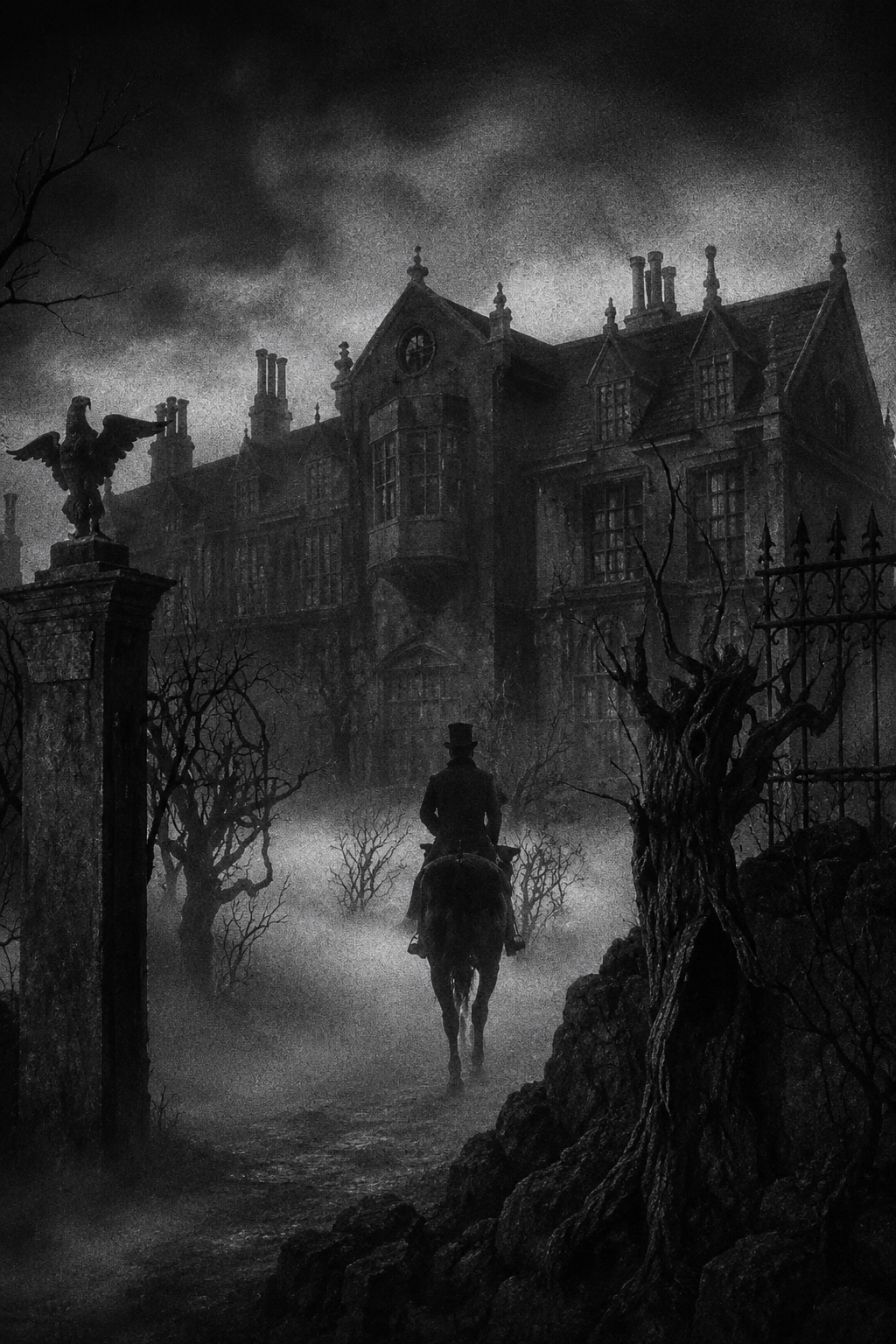
The Sound Beneath the Floor by Dušan Ripley
Contents
I. The Field That Has Already Burned
II. The Slippers
III. The Monster Is the Architecture
IV. A Man Made Entirely of Reception
V. The Gallery VI. What the Lute Is For
VII. The Woman from Boston
VIII. The Hand in the Coffin
IX. The Dream That Belongs to the Visitor
X. The Empty Box
XI. A Vertical Story in a Horizontal Frame
XII. The Countdown Written on the Wall
XIII. Fire as Interior Weather
XIV. The Water and the Sentence
Coda: The Carrier
I. The Field That Has Already Burned
Before the film shows a face it shows a soil, and the soil is finished.
A rider crosses ground that no longer produces anything. The trees stand, but they stand the way scaffolding stands after the building has been taken away: upright, black, articulated, without function. Mist lies in the hollows at a height of perhaps three feet, which is the height at which mist stops being weather and becomes a substance the horse must wade through. There are no birds. This is the detail that does the most work and announces itself least. A landscape without birdsong is not a quiet landscape; it is a landscape from which a whole register of the audible has been surgically removed, and the ear notices the removal before the mind can name it. The rider will spend the rest of the film complaining that the Ushers cannot bear sound. He has already ridden through the proof that sound has been abolished here, and he has not heard it, because the abolition of sound is precisely the thing that cannot be heard.
The exteriors were photographed in a burn scar. A fire had recently gone through those hills, and the production went to the ash while it was still fresh, because ash was cheaper than art direction and more convincing than either. What this economy produces is a formal fact of remarkable consequence: the first images of the film are documentary records of a fire, and the last images of the film are a fire. The picture opens in its own aftermath. Before anything has happened, we are looking at the cooled residue of what will happen. Time in this film does not run forward from a beginning to an end; it circles a single event that has always already occurred and is merely waiting for the characters to catch up with it.
This is not symbolism. Symbolism would require that the dead field stand for something absent. The field stands for nothing. It is simply the same matter, in an earlier state of the same process, and the process is combustion. To ride toward the House of Usher is to ride backward into a fire, and the closer the rider gets to the house the more colour appears, which is to say the more heat. Outside there is grey, brown, the drained blue of standing water. Inside there will be crimson, gold, a green like something growing in a jar. The conventional gothic sends a living man into a dead place. This film inverts the polarity with complete confidence: the world is the dead place, and the house is the last object in it with any temperature.
The tarn is introduced early and treated with a curious lack of emphasis. It is water without motion, water that has stopped being a fluid and become a lid. Nothing enters it, nothing leaves it, nothing lives in it. The horse balks at its edge. Animals in this film possess the epistemology that the human beings lack: they know the difference between ground you can stand on and ground that is already a grave, and they refuse. The rider dismounts and continues on foot, which is the first of the film’s many small confiscations. The house takes his horse before it takes anything else. It takes, that is, his means of leaving, and it does so within the first minutes, so gently that neither he nor we register it as a taking.
Notice how the composition is organised. The rider is placed low in the widescreen frame, and the frame is mostly sky — a sky the colour of a dirty window, offering neither weather nor light. The house, when it appears, appears as a painting: a matte, flat, hung in the middle distance like something already framed and hanging on a wall. This is usually described as a limitation of budget. It is more useful to describe it as an accuracy. The house is introduced to us as an image of a house, because that is what it is going to remain. Nobody in this film ever sees the House of Usher whole from outside except in that painted view. The characters live inside a structure whose exterior exists only as a picture, and the film’s most persistent proposition — that the past is something one lives inside rather than something one looks at — is stated in that single flat matte before a word has been spoken.
What does the camera know here that the rider does not? It knows the ground. It knows that the field is not a prologue to the house but a report on it — that the desolation is ...