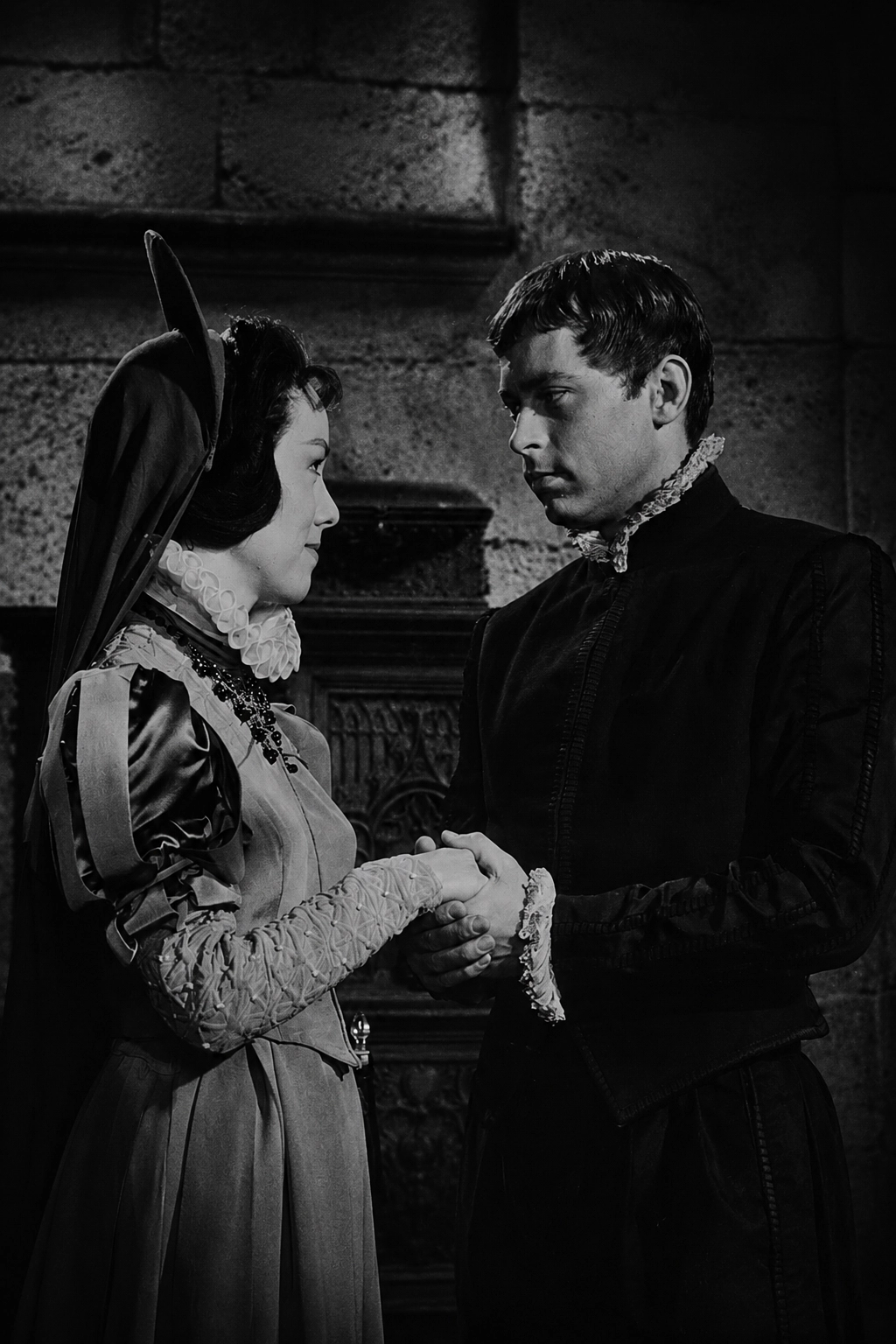
The Width Of The Arc
by Dušan Ripley
The Work
Pit and the Pendulum — American International Pictures, 1961
Directed by Roger Corman Screenplay by Richard Matheson, from the story by Edgar Allan Poe
With Vincent Price, John Kerr, Barbara Steele, Luana Anders, Antony Carbone
Cinematography: Floyd Crosby · Art Direction: Daniel Haller · Music: Les Baxter Panavision · Pathécolor
Contents
I. The Coach That Stops Short
II. The Escapement
III. The Inherited Machine
IV. Testimony
V. The Wall
VI. Two Women, One Face
VII. Descent
VIII. The Chemistry of Light
IX. What the Harpsichord Knows
X. The Performance
XI. The Second Man
XII. The Arc
XIII. The Sealed Room
XIV. Coda: The Width of the Arc
I. The Coach That Stops Short
Before the film has a landscape it has a temperament. The credits arrive as liquid: pigment blooming and folding into itself, blue devouring red, a green that thins and separates the way something dissolves rather than the way something grows. There is no horizon, no figure, no measurable scale — nothing by which the eye can establish where it is standing. For the better part of two minutes the screen is occupied by matter that has not yet consented to become an image. This is not ornament. It is a statement of order. The film will proceed from the inside outward. First the disturbance; then the architecture built around it.
Then the coast. Grey water, grey shingle, a sky that was painted rather than photographed, and along the cliff a silhouette assembled out of turrets and crenellations belonging to no century in particular. The wide frame is deployed against its own nature. Panavision promises panorama and is handed vacancy: no village, no traffic on the road, no second structure anywhere in the visible world. The format that exists to accommodate abundance has been given one building and a great deal of nothing, and the nothing is the point. A castle in a populated country is a residence. A castle with no country around it is a condition.
The coach halts short of the gate. The driver will not continue and offers no reason the film considers worth recording; he names a distance and declines to cross it. This is the first of many refusals, and it establishes a principle the film will observe with unusual discipline: the world outside possesses knowledge about this house which it will not articulate, only act upon. Superstition here does not take the form of belief. It takes the form of a stopped vehicle.
The visitor walks the remaining ground alone. Francis Barnard arrives from a place the film will never show us — an England of families and businesses and ordinary Tuesdays, asserted in dialogue, granted no photograph. His coat, his manner, his rectitude are the only evidence that elsewhere exists. And the film is careful never to corroborate that evidence. He does not depart at the end into a visible world; there is no exterior for him to return to. This is the first quiet cruelty of the design. The man who comes to impose the standards of the outside upon this house has brought those standards from a country the camera declines to confirm.
Note what the film does with light at this threshold. The exteriors are drained — chalky, undersaturated, closer to a lithograph than to a photograph. The interiors, when we reach them, are chromatically extravagant: reds that have no source, blues laid over stone like weather, amber pooling in corridors where no lamp is burning. The ordinary hierarchy has been inverted. Normally the outdoors is where colour lives and the indoors is where it is rationed. Here the outside is a proposition and the inside is a fact. The world is pale; the house is vivid. Reality has been relocated to the interior, which is precisely what a mind does when it stops being able to leave itself.
He is met at the door and refused. Then, after negotiation, admitted. Consider how many times this film stages that exact transaction — a person at a threshold, a person deciding, a door opening a measured amount. It happens at the gate, at the bedroom, at the crypt, at the chamber, and finally at a slot the width of two eyes. The film’s basic unit of event is not violence and not revelation. It is admission into a container. Every character in the story is, at some point, let into something that will then be closed.
The castle’s exterior, we are told, stands upon rock above the sea, and the sea can be heard from within. The film returns to this sound with a regularity that has nothing to do with atmosphere. It is a structural sound. Stone endures; water removes. A house built on a cliff above a working sea is a house on a countdown, and the countdown is audible in every room where the characters believe themselves to be standing still. Long before any machine is shown, the film has already installed its subject beneath the floor. Something is being taken away at a steady rate. The rate is the horror.
There is a further refusal worth marking. When Francis asks his questions in the first movement of the film, he is not lied to. He ...