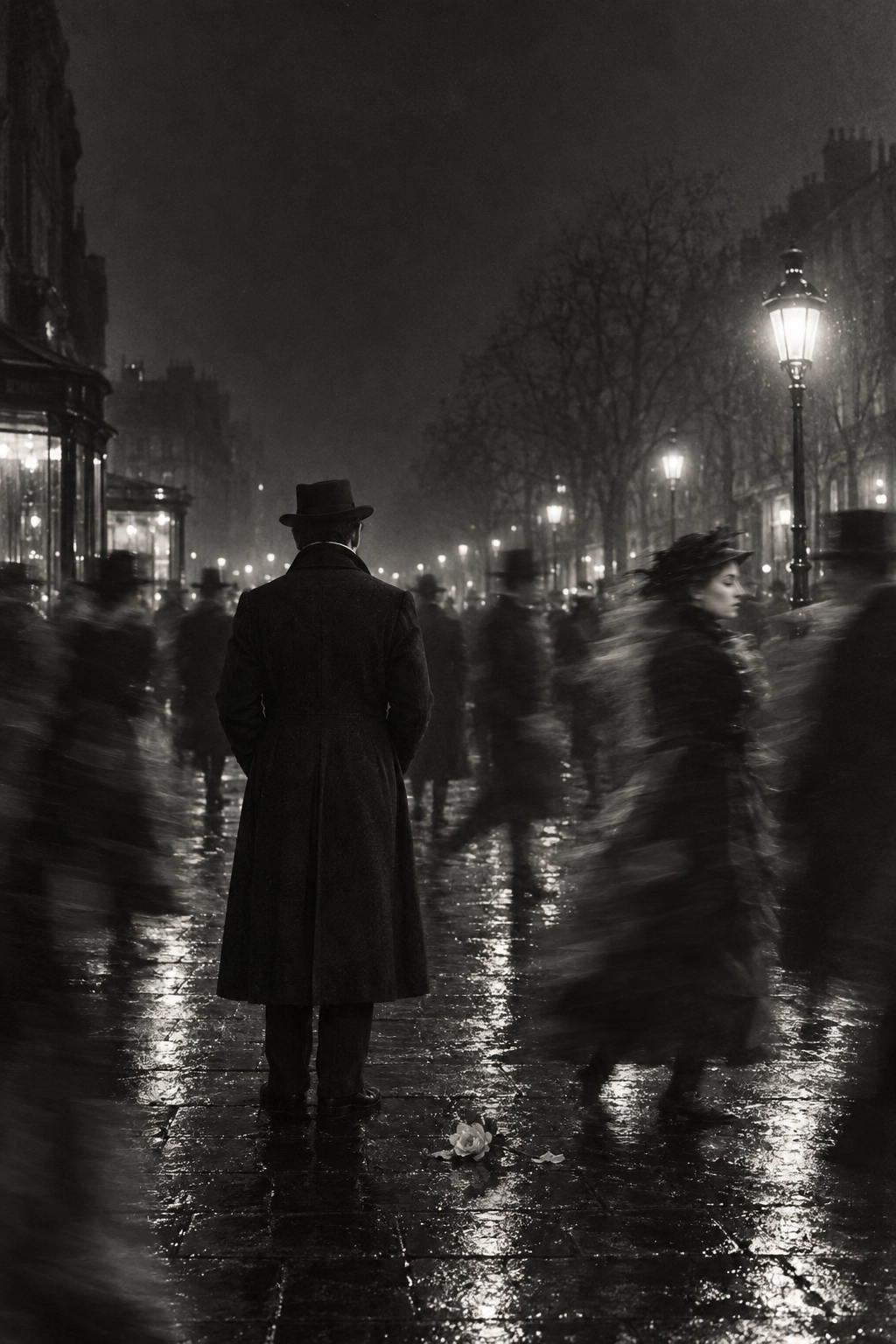
A man in a bathrobe comes out onto the pavement to look at the accident. He has a woman with him, and the two of them join the small crowd that a body in the road collects at night: a policeman, a few faces, a press photographer with his camera. Before the picture is taken, an old peddler steps up to the man in the bathrobe and offers him a comb. The man has no reason to want one. He takes it anyway, and a moment later, when the photographer raises his camera, he runs it through his hair. That is the last gift in “What You Need,” and it is made a few feet from the corpse of Fred Renard, whose death the same peddler has just arranged with a pair of shoes.
The comb is a small joke, and Rod Serling’s closing narration hurries in over it to name the victim and pass sentence on him. But the joke is also the most exact statement the episode makes about its own practice. The peddler, Pedott, does not give people what will make them rich or safe or wise. He gives them the thing the next few minutes will require: a comb before a photograph, a bus ticket before a telephone call, a bottle of cleaning fluid before a stain. His foresight is short and his goods are cheap, and the drama comes from a man who cannot accept either limit. Renard wants what the man in the bathrobe is never offered and would not know what to do with: the source rather than the object, the whole of tomorrow rather than the next minute, everything rather than one thing.
What lifts the episode above that summary is the confession Pedott makes before the crowd arrives. Alone with Renard’s body, speaking to a man who can no longer hear him, he explains that the shoes were not what Renard needed. They were what he, Pedott, needed. For twenty-five minutes the story has been conducted in the grammar of its title, the second person, the address of a salesman to a customer: what you need, sir; what you need, Mr. Renard. In its last minute the pronoun turns round. The gift-giver admits that the final gift was for himself, and then, as if to shrink the admission back to a bearable size, he gives a comb to a stranger and walks away into the next night’s work. The episode’s subject lies in that turn, in the distance between “you” and “I,” and in what it costs a modest man to cross it.
Every Night
The bar in which the episode opens is the kind of place where people are alone together. There is a long counter, a bartender who knows everyone’s habits, a few tables, and a telephone. The customers we are shown have arrived at the end of something. Lefty, played by Read Morgan as a big man made clumsy by drink and grievance, was a pitcher until his arm went, and he talks about the arm the way a man talks about a house that burned down. A young woman sits by herself at a table, the only woman in the room, and her solitude is treated by the bar as a fixture rather than a scandal. And at the counter, with a drink and a cigarette, sits Fred Renard, on whom Serling’s voice fastens before Renard has done anything at all.
The opening narration is unusual even by the standards of a series that liked to prejudge its protagonists. It does not describe a situation; it describes a character, and it does so as a verdict. Renard carries a chip on his shoulder, we are told, “the size of the national debt,” and behind him lie thirty-six years that the voice calls undistinguished, meaningless, pointless, failure-laden.[^1] The adjectives arrive in a row like blows. Then the voice turns to the small old man who has come in with a case, and announces that this is just what Mr. Renard has been waiting for. The phrasing is worth pausing over. The old man is presented as the thing Renard needs, in the sense that a drowning man needs a rope; but the sentence also has the shape of a warning, since what Renard is waiting for is a way out, and the episode will show that the way out he takes is the wrong one. The narration, in other words, has already told us what Renard will do with a gift. It has not told us what Pedott will do with a threat, and that is the question the episode leaves open until the wet street at the end.
Pedott’s entrance is deliberately unimpressive. Ernest Truex was seventy when the episode was broadcast, a veteran of the stage who had been a child performer in the 1890s and a Broadway juvenile before the First World War, and he brings to the part a lifetime’s practice at being small on purpose.[^2] He carries his case in front of him like a tray, opens it with a little ceremony, and offers its contents with a soft, deferential question, calling the customers “sir” as though they were his betters. He handles the goods as a shopkeeper would, with the small care of a man for whom a bottle or a ticket is merchandise first and prophecy second, and the care never ...