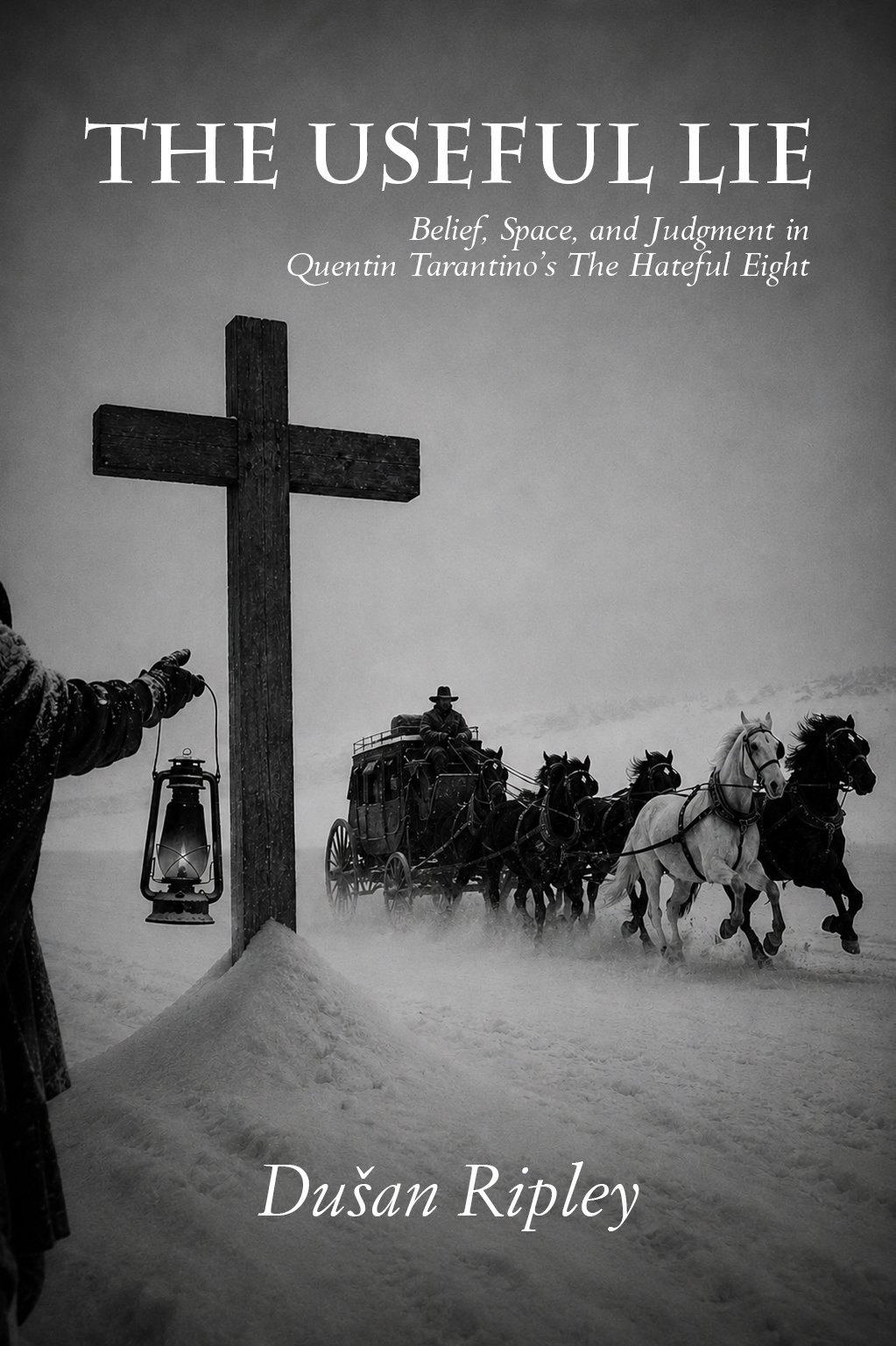
THE USEFUL LIE
Belief, Space, and Judgment in Quentin Tarantino’s The Hateful Eight
A room. Eight strangers. A storm that closes every exit. Everyone has a story, everyone has a reason to lie, and almost nothing can be verified.
The Useful Lie is a book-length critical study of Quentin Tarantino’s The Hateful Eight—a film in which truth is constantly present, yet rarely possesses the authority to matter. Moving from the roadside crucifix and the stagecoach to the claustrophobic interior of Minnie’s Haberdashery, the book examines how Tarantino transforms space into suspicion, conversation into evidence, and judgment into an act performed long before certainty becomes possible.
Through close attention to framing, architecture, doors, objects, silence, music, performance, racial memory, violence, and the stories characters tell about themselves and one another, The Useful Lie argues that the film’s central conflict is not simply between truth and deception. It is between what happened and what people are prepared to believe happened.
The haberdashery gradually becomes more than a room. It becomes a political and judicial machine: company turns into surveillance, suspicion into accusation, accusation into hatred, and hatred into permission to punish. Tarantino’s unusually wide frame intensifies the paradox. Everything appears exposed, yet crucial knowledge remains inaccessible. Everything is visible; nothing is seen.
At the center of the book lies the film’s most unsettling proposition: people do not always believe because evidence has persuaded them. They classify, judge, choose—and then make the evidence fit. Stories acquire power not necessarily because they are true, but because somebody needs them to be true.
And by the end, after a film devoted to testing stories, documents, identities and testimony, The Hateful Eight arrives at its strangest destination: a lie whose falsity is known, but whose usefulness survives the discovery.
The Useful Lie is not a retelling of The Hateful Eight, nor a conventional film review. It is an extended essay on belief, judgment, race, authority, punishment and the fragile agreements by which human beings decide what counts as truth.
100 Pages · Short Book · Digital Edition .PDF · English
Prologue — A Wooden Face in the Snow
The first face in The Hateful Eight is made of wood, and it cannot see.
Before there is a story, before anyone speaks, before the audience has been given a single name to hold, the film offers a carved figure of Christ on a roadside crucifix, snow banked along the arms and shoulders, the paint long gone from the cheek, the eyes hollowed by weather into something between agony and indifference. The camera does not glance at this. It stays. It gives the image the duration of an argument. And because the shot is held, the viewer begins to do what viewers do when a film insists: search the object for meaning, assign it weight, prepare to carry it forward as a key.
Then the camera withdraws.
It pulls back slowly, and as it retreats the crucifix loses its monopoly on the frame. Mountains arrive at the edges. Snow accumulates in the foreground. The figure that seemed to be the subject becomes a fixture at the side of a road, a piece of frontier signage, a marker some forgotten traveler planted and no one has maintained. What was a symbol becomes a landmark. What promised to organize the film’s meaning is demoted to geography.
This retreat is the founding gesture of the film, and it should be understood as a warning rather than a flourish. The Hateful Eight will repeatedly offer objects, documents, faces, and stories that appear to hold the truth of a situation, and it will repeatedly widen the frame until those things are revealed as furniture in a landscape whose real order lies elsewhere. The film trains us in the first ninety seconds to over-read, and then punishes the over-reading. By the end we will have learned to distrust exactly this reflex — and the film’s last movement will require us to abandon what we learned and believe something we know to be untrue.
Notice also what the wooden figure is: a man fixed in the air, arms out, weight hanging from a fastening, unable to come down. The film’s final living body will also be lifted off the floor, also fixed, also unable to come down — a woman raised by the neck from a beam inside a house. Between the crucifix and the rafter lies everything the film has to say about punishment. It begins with a hanged god at the edge of a road no one travels and ends with a hanged woman at the center of a room no one will leave. Neither death is witnessed by any authority higher than the people standing nearest.
Into this vast white nothing comes a stagecoach, and with it Ennio Morricone’s principal theme, a slow procession of low brass and bassoon and struck strings that does not sound like a western. It sounds like something approaching from underneath. Westerns traditionally score arrival with rising figures, with the promise that space is opportunity. This music descends. It converts an image of freedom — six horses running through open country — into an image of something being delivered somewhere it should not go. Before we have met a single character, the score has told us the genre is lying about itself.
And here we should name the film’s central formal paradox, because everything in this book proceeds from it. The Hateful Eight was composed for the widest image a narrative filmmaker can practically obtain, an ultra-wide anamorphic frame whose horizontal reach exceeds two and a half times its height. It is a shape invented for scale: for chariot races, for armies, for the parting of seas. Tarantino acquires this instrument and then spends the majority of the film inside a single wooden room roughly the size of a modest barn, populated by eight or nine people who mostly sit down.
The obvious reading is that the disproportion is a joke — an expensive format wasted on a cabin. The obvious reading is wrong, and the film corrects it within twenty minutes of entering the haberdashery. The ultra-wide frame does not make the room feel large. It makes the room feel inescapable, because it can hold every occupant simultaneously. In a conventional frame, characters exit the image and are provisionally forgotten. Here, when two men argue at a table, three others remain visible at the edges — sitting, listening, drinking, saying nothing. The width does not offer air. It offers company. It guarantees that no one is ever alone, that every private exchange has an audience, that every word lands in a room already full of ears. Width becomes the visual equivalent of surveillance.
And yet — this is the film’s great trick, the one on which its central structure turns — the widest available image will fail to show us the single most important physical act in the story. Someone will cross that room and put poison in a coffee pot, in plain view of a frame designed to make concealment impossible, and neither the camera nor the audience will register it. The film will have to stop, and a disembodied voice will have to explain to us what we did not see.
That is the subject of this book. Not who is lying — the film is generous with that information sooner than its reputation as a whodunit suggests — but what it costs to believe anything in a room where verification is impossible, and what people build out of fictions they cannot check.
For the story that follows is not, finally, structured around a murder. It is structured around a document. A Black cavalry officer carries in his coat a letter he says was written to him personally by Abraham Lincoln. The letter is warm, plain, domestic; it mentions the President’s wife calling him to bed. It is passed from hand to hand. It is read aloud. It is wept over, spat upon, argued about, folded, unfolded, and finally, in the last shot of the film, read aloud a second time by a dying man to another dying man in a house full of corpses. It is also a forgery, and its owner knows it.
The film’s title asks us to count. Eight hateful people, presumably the eight who converge on Minnie’s Haberdashery. But any honest count of that room comes out wrong. The number only works if you decline to count the stagecoach driver — the one man in the building with no scheme, no grievance, and no bounty, who dies horribly and early. It only works if you decline to count the man beneath the floor. It only works, above all, if you decline to count the six people who lived in that house until the morning of the day the film begins, and whose murders precede the first frame. The title is a sum that requires exclusions, and the film spends three hours showing us who gets excluded from sums.
What follows is a reading of the film from its first wooden face to its last piece of paper: an account of how a road becomes a room, how a room becomes a courtroom, how a courtroom becomes a slaughterhouse, and how the slaughterhouse, at the very end, becomes something almost unbearably like a home.